Blockbuster Scarborough Budget Waits for Fairy Dust

Sometimes living in Scarborough is like being in a fairy tale… especially during budget season. Common sense and financial prudence go out the window, and fantasy and wishful thinking rush in to replace them.  For example, consider the “first reading” of the Fiscal 2018 budget that the Town Council unanimously approved on April 5…

Here are a few of the key increases in the proposed Fiscal 2018 budget:


Being a good budget citizen…

Before we go any further, let’s take a deep breath and reflect on the budget process as it has played out over the past few years.  We need to remember that “the budget” is presented in a 394-page book (link here).  It consists of literally thousands of numbers.  Some of the numbers are more important than others, and reasonable people may legitimately disagree on the relative importance of any particular number.

We need to be very careful when we talk about specific numbers.  For instance, any of the three increase categories above could be accurately given as representing “the budget” or major components of it.  At LookOutScarborough, we try to be very precise when we talk about budget amounts.

In past budget cycles, there have been loud and sometimes strident accusations of one group or another providing “misleading” or “inaccurate” information about the budget.  Most of these accusations arose because of differing perspectives on what is or is not important in the budget.

So please… be precise when you quote budget numbers.  And remember that there are different ways of interpreting the numbers.  No one – including members of the Town Councilor – has a monopoly on the correct interpretation of the budget.

Dismounting now from our high horse, let’s get down to the business at hand.

1.   State funding of the schools will be down $1.4 million this year (subject to change based on what happens to the State budget, which will probably not be known until after our budget is finalized).  A decrease of this magnitude is not a surprise; it has been expected for a few years.  Although we may debate whether the State funding mechanism is “fair” or not, that’s not a particularly productive exercise.  The State funding is what it is.  We need to adapt to its reality.

2.  The so-called “level funding” of the schools will increase by 4.9%.  This means the schools’ expenses will increase about 5% just to keep on doing what they are currently doing.  That is, a 5% increase just to maintain the status quo.  Of course the main reason for this large increase is the teachers’ contract that the School Board agreed to last year.  This year’s impact of that contract is about a 4.7% increase in teacher salaries and benefits… or perhaps more, if health insurance premiums increase more than expected.  (Taxpayers pick up 80% of the school employees’ health insurance premiums.  We don’t think even Santa’s Elves Union has that good a deal anymore.)

3.   In spite of items #1 and 2, the schools are also planning to add about $300,000 of expenses associated with 4.8 FTE new employees.  In most prudent organizations that are facing financial challenges, attempts are made to reduce costs, not increase them.

4.  The budget uses $2.1 million of surplus funds from prior years (known as “fund balance”) to offset the financial drain caused by the above factors.  As a frame of reference: in Fiscal 2015 and 2016, the schools generated a total of about $4.5 million of surpluses.  That’s essentially our tax money that was collected in excess of what was used.

5.   Municipal expenses will increase by 2.9%.  Municipal revenues (excise taxes, program/service fees, etc.) will increase by 2.7%.  In addition, the budget describes in detail the need for four new firefighters but does not include the $290,000 cost to fund this need.

And that, dear taxpayer, is how we arrived at those horrible increases that started off this blog.  In our next blog posting we will provide our usual one-page budget summary that connects the dots and shows how the numbers are related.  We guarantee it will be easier than slogging through a 394-page document… and probably more informative.


Bring on the fairy dust!

After Mr. Hall and Ms. Kukenberger gave the budget overview presentation at the Council meeting, members of the Council provided their reactions.  While there was a general consensus that this was a starting point and there was still work to be done, most Councilors seemed well pleased with the budget at this point.  Some hailed it as the best starting point in years.

Wait.  The budget presented a total tax rate increase of between 5.8% and 7.1%.  That compares to the goal set by the Town Council of “about 3% or less.”  So coming in with a tax rate increase of double the goal is a good thing?  (Paging Dr. Goldilocks.  Patient with delirious optimism in room 6.)

And for the record… Last year’s budget starting point had a projected tax rate increase of 3.27%, compared to this year’s 5.8% to 7.1%.  So saying that this year’s starting point is “the best in years” is just not supported by the facts.

The reactions of several Town Councilors are cited in The Forecaster’s article about the unveiling of the budget (link here).  See for yourself.  Better yet, watch the comments in the video-on-demand of the Council meeting (link here). The comments start at 2:03:00 of the video.

It’s going to take a ton of fairy dust to remove the odor of financial imprudence from this budget.  Remember, we still think Fiscal 2018 should be the year of no tax increase.  It’s going to be an interesting budget process! 


Slogans for Budget Season

Marketing slogans often make us nervous.  It always seems like someone is trying to sell you something you don’t need.  Or trying to make their product into something it’s not.

So we were naturally skeptical when the Town rolled out the slogan for the Fiscal 2018 budget season – “One Town, One Budget.”  We’re not sure just what sort of warm and fuzzy message this is supposed to convey.  Perhaps that questioning the budget is a divisive act that may damage the Town’s reputation?   At the very least, the slogan seems like an attempt to divert attention from the real driver of our tax increases – school funding issues.
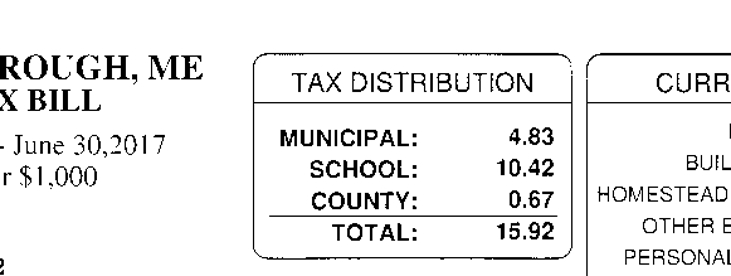
No matter what the slogan is intended to convey, it doesn’t match up with the basic reality of our property tax system.  There are actually three budgets that go into our tax bills – municipal, school and county.  This fact can be readily confirmed by pulling out your tax bill and seeing the breakdown of the tax rate.

The county budget gets set by the Cumberland County Commissioners and a portion of it is passed on to each city or town.  At the Town level, we have no say in the county tax.  The municipal budget (fire, police, public works, etc.) is prepared by the Town Manager and approved by the Town Council.

The school budget (which accounts for about two-thirds of our tax bill) is prepared by the School Superintendent, approved by the School Board and then has its total spending level approved by the Town Council. And then the school budget – and only the school budget – goes to the Town’s voters for approval. 

The school budget is the only budget of the three budgets over which the Town’s voters have direct influence.  When we vote on June 13, we are voting only on the school budget.  As it stands now, voters would be asked to approve a 9.6% increase in taxpayer funding of the schools.  The June 13 vote is our only direct opportunity to influence next year’s tax rate.


Looking ahead

Now that LookOutScarborough has survived three full budget cycles, we have a pretty good idea of how the game is played.  In the next blog, we’ll provide important data and analysis, and let you know what to expect during the next couple of months.  Here’s what we plan in our next blog:

  • The fine art of budget choreography.

    A one-page budget worksheet that allows even a non-CPA to see all the major components of “the budget” and how they fit together.

  • Some of the tactics we expect will be employed as the budget process unfolds. (Who can forget the elimination of 7th grade sports a couple years back?  Or the miraculous discovery of $400,000 of unexpected excise tax revenue last year?)
  • Our fearless prediction of the school budget funding level that will end up going out to the voters on June 13.

Happy trails until we meet again!

Be neighborly,

TT Hannah


Scarborough Facilities Plans May Shock!

Well, friends and neighbors, here we are again in late March.  With too much snow still on the ground and a mean chill still in the air.  And with April Fool’s Day close at hand. 

We begin with our oft-promised, extremely unofficial Ten-Year Projection of Scarborough’s Facilities Plan.  Apparently town and school officials are in the final stages of preparing the “official plan,” but we wanted LookOutScarborough readers to be suitably prepared before that plan is released.  Especially those readers who are at risk for cardiac events.

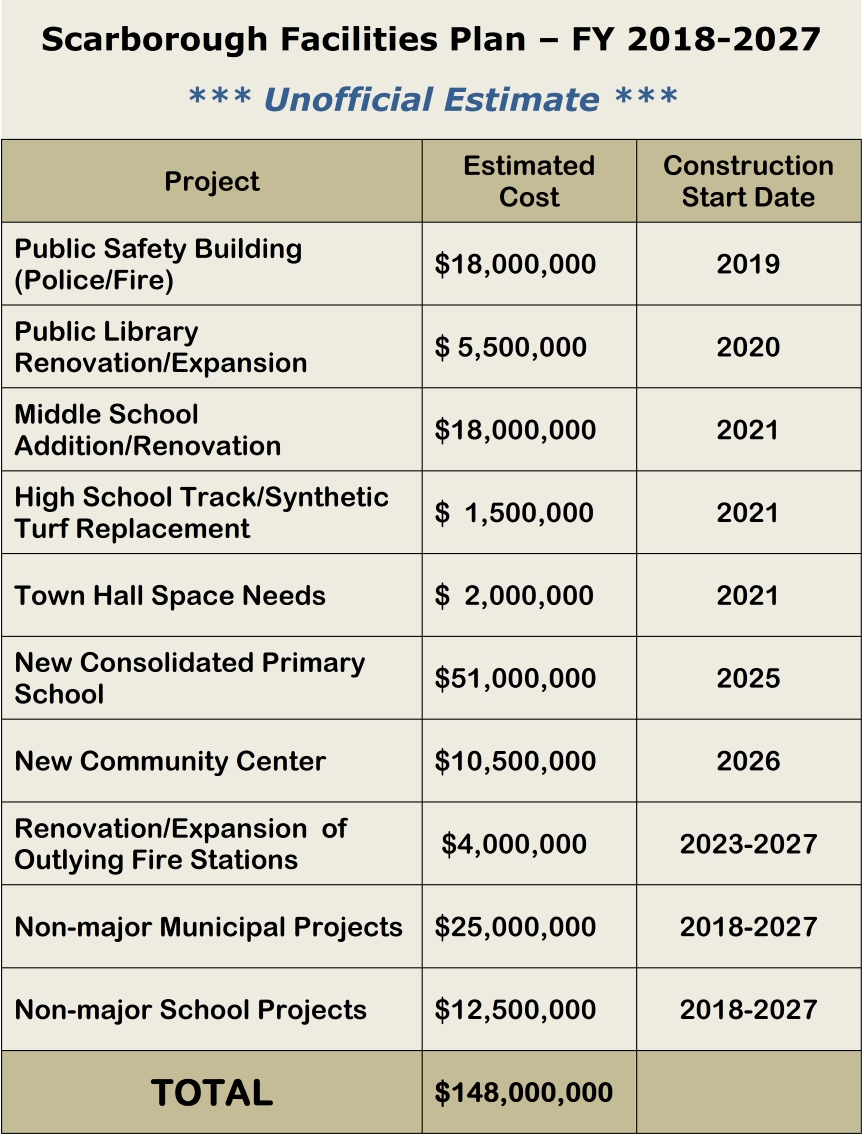
The summary that follows was prepared by reviewing various town and school reports.  In addition, we consulted a Magic 8 Ball, a Ouija Board and Madame Alakazam, the noted Old Orchard Beach psychic.  Which is to say that our projection is a blend of verifiable data and unabashed guesswork.  All of the projects are “real” in that they have been proposed in town and school reports.  The estimated costs are likewise grounded in data from reliable sources.  The timing of the projects is, on the other hand, made up based on our gut feeling.  It will be interesting to see just how much capital spending (and related borrowing) town officials are willing to propose in the official plan.

Here’s our take on capital projects for the next ten years:

Perhaps two or three of these projects will get pushed out beyond the ten-year timeframe.  Or will be substantially reduced in scope and cost.  But even if we knock a third of the cost out, we’re still looking at $100 million of facilities investments over the next ten years.  That’s a sobering thought…especially in view of the Town Council’s obvious willingness to increase the tax rate by 3% a year – or perhaps just a teenie bit more – year after year after year.


Paying for it all

The obvious question is, how do we taxpayers pay for all these capital projects?  The equally obvious answer is, by taking on more debt.  Unfortunately, we already have nearly $100 million of debt outstanding, an amount that ranks us right up there – if not at the top – in debt per capita of neighboring communities.

Here’s a summary of our current debt situation:

By comparison, each resident’s share of town debt in Cape Elizabeth is $1,700.  In Yarmouth it’s $1,809 of debt per person.

And we’re considering adding another $100 – 150 million in debt?  Yikes!  Seems like a lot.

But no worries… our debt advisor says we can issue lots more debt without any problem.  So bring it on!


Budget Update and a Proposal

We still haven’t learned enough about the Fiscal 2018 budget to share a meaningful analysis.  Dribs and drabs of information come out here and there… the addition of a few part-time positions, the $900,000 increase in teachers’ salaries associated with the new contract, significant increases in health insurance premiums, etc.


One thing we keep our ears open for is some hint of cost-saving efficiencies or perhaps the consolidation or elimination of a position or two.  But, alas, no such news seems to be forthcoming.


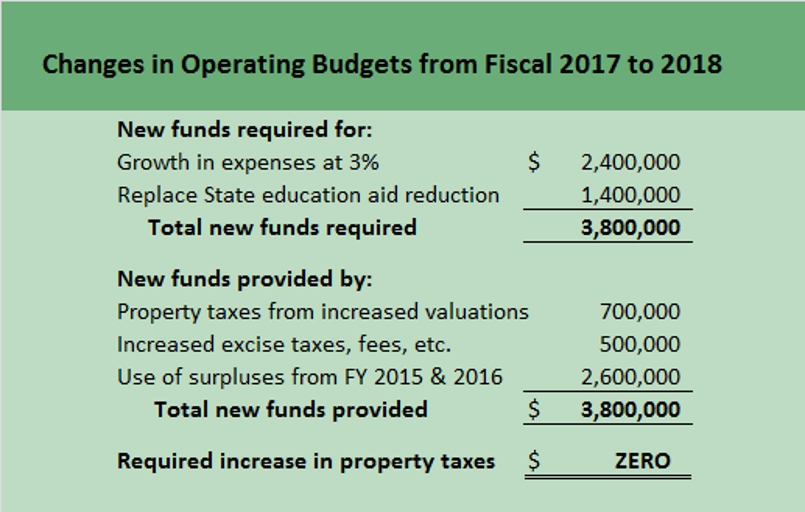
So in the absence of new information, here’s LookOutScarborough’s Budget Masterplan for Fiscal 2018.

Expenses will be prudently managed:

  1. Municipal and school expense growth will be limited to 3% or less. This seems like a reasonable increase in view of low inflation and essentially flat school enrollment.
  1. State school aid reduction of $1.4 million will occur. (While the amount is not certain, a significant reduction is highly likely…there’s nothing we can do about it.)

Partially offsetting the costs of the above two increases will be:

  1. Tax revenue will grow automatically as new properties come on the tax rolls and some existing properties get reassessed at higher values.  (Every time a new $300,000 house/unit comes online at, say, Eastern Village, the Town gets about $4,800 of new taxes.  So if 100 new homes get added in a year, that’s $480,000 of new tax revenue… without raising the tax rate.)
  1. Revenue will also grow automatically as excise tax revenue increases. As residents buy new cars, the Town benefits from increased collection of excise taxes.

To the extent that additional revenues (#3 & 4) are not enough to cover additional expenses (#1 & 2):

  1. Surpluses generated in Fiscal 2015 and 2016 will be used to cover any shortfall of new revenues not covering new expenses. The Town socked away surpluses of about $4.5 million in those two years. Remember, those surpluses are essentially your extra tax dollars that were collected over and above what was really needed.

The net result: no tax increase in Fiscal 2018! 


This chart summarizes the arithmetic of a no-tax-increase budget for Fiscal 2018:

Too simple?  Too reasonable?  Perhaps both… but still a realistic possibility if town leaders were serious about financial discipline and minimizing tax increases.  Never mind a 3% tax rate increase… let’s make Fiscal 2018 the year of no increase!


Coming very soon… The Scarborough Downs Saga

A parable for our times, in which transparency is whisked away in a dark sedan with tinted windows and never seen again.  And the will of the people is traded for three magic beans.

All the details next time.

In the meantime, we like PLAUSIBLE DENIABILITY in the third race on Sunday.


Happy trails until we meet again!

Be neighborly,

TT Hannah

2016 Scarborough Surplus Surge!

los-surplus-surge

Has it ever struck you as odd that we spend 3 or 4 months of frantic effort developing municipal and school budgets for the year and then pay almost no attention to how we actually performed compared to those budgets?   Well, yes, it is odd.  And, as with many aspects of how Town Hall operates, there’s probably a reason for it.  Whether it’s a good reason or not is for you to decide…

But have no fear – LookOutScarborough will shine the bright lights of transparency and elucidation on how Fiscal Year 2016 turned out…  and share the important implications for future budgets and tax rates. 

(We realize that a review of financial results isn’t a particularly entertaining topic.  But please bear with us; it’s critical to understand the municipal and school financial performance.  We promise to keep it brief and jargon-free.)


The numbers

los-numbersEach year the Town prepares a comprehensive annual financial report.  At 143 pages of numbers and accounting terminology, it’s not exactly a quick or easy read.  (See for yourself at this link.)  For most folks, it might as well be written in Greek.  So here’s our quick and dirty summary of what really happened financially in Fiscal 2016…

The following page of numbers — the only one you will be subjected to in this blog entry — summarizes the Town’s financial performance compared to the budget in Fiscal 2016 (which ended on June 30, 2016).  Please take a quick look at it, or just skip right to the conclusions that follow it.

los-fy16-budget-actual

This schedule essentially condenses all the Town’s significant municipal and school operating activities on one page.  Now a CPA could quibble with some of the terminology and presentation in the schedule, but he or she would probably admit that it’s a fair summary of our core financial activities in Fiscal 2016.

And as you can see from the bottom line, revenues exceeded expenditures by $2.5 million. The more technically correct term for the Town’s bottom line is the “change in fund balance.”  While that’s not exactly the same as “net income” in the commercial world, it’s the same concept.  The budget is designed so that real estate taxes and other revenue sources cover all expected expenditures, thus the budgeted bottom line of zero, or break-even.  But due to a combination of factors, we ended up 2016 with $2.5 million more than needed to cover actual expenditures.  Not bad at all.

While a number of factors contributed to this excellent financial performance, the one area that stands out is school operations with a favorable expense variance of $2.5 million.  That is, the schools spent only $41.2 million, as opposed to the $43.7 million that they budgeted. 

Those of you with a sharp memory will instantly say to yourselves: “Aha! The Wentworth Windfall rears its ugly head once again!”  And you will be correct… about $1.4 million of the favorable school budget variance is due to the unanticipated infusion of cash from our over-borrowing on the Wentworth School project.  (For a refresher on the Wentworth WIndfall, click here.)

The take-away message:  The Town generated $2.5 million more than expected in Fiscal 2016.  Or, put another way, collected $2.5 million more in taxes than was necessary to cover actual expenditures.


A trend or a fluke?

"Up from the ground came abubblin' crude"

“Up from the ground came abubblin’ crude.”

So was the exceptional financial performance in Fiscal 2016 a fluke?  No, it wasn’t.  In Fiscal 2015, the excess of revenues over expenses (or change in fund balance) was about $2.0 million.  That’s a total of $4.5 million more than expected in the past two years.  And as the following chart from the independent auditor’s overview of Fiscal 2016 confirms, the general fund balance (essentially accumulated annual surpluses) has grown nicely over the past three fiscal years – from about $9.6 million to $14.2 million.

los-fund-bal-06-30-16Source: Macpage LLC’s Town of Scarborough Financial Statement Presentation, June 30, 2016.  Link here.


Here’s how total real estate taxes have grown in the same period:

Same source.

How many Scarborough residents have seen their incomes grow at a similar rate over that period?


A modest proposal

los-modest-proposal

All of which leads us to a proposal on what to do with those surpluses generated in the last couple of years: use a portion of them to pay for the growth in expenses in the Fiscal 2018 budget which is being developed now.   The result – no increase to the current tax rate of $15.92.  At current expense levels, a 4% increase* in spending of both municipal and school budgets would produce about $3.1 million of additional expenses in Fiscal 2018.    So let’s use a portion of those surpluses of the last couple of years to pay for the expense increases in Fiscal 2018 and leave the tax rate unchanged.

Some members of the Town Council want you to believe that the tax rate has to increase by 3% every year.  Tain’t so!  If expense increases were controlled and past surpluses were applied judiciously, the tax rate could actually be held unchanged.  Let’s try it for a year and see how it works!  Remember, those accumulated surplus funds are your tax dollars!

___________________________________

*Yes, a 4% increase is too high.  It’s the root cause of our steadily increasing tax rate.  But that’s our current reality, unfortunately.


Coming soon…

Since we try to limit ourselves to one wild and crazy idea per blog, that’s it for this time.  But we have lots on our plate for the next few blogs:

  • The outlines of the budget challenges for Fiscal 2018 are just starting to emerge. We’ll keep you posted, as always.  In the meantime, it might be helpful to look into yoga classes or other stress-reduction options.  It could be a difficult budget season.
  • In another Pine Point land deal, the Town Manager is negotiating with Mr. Gendron over Mr. Gendron’s claim that he owns half of the Avenue Two Extension. We’ll follow this closely.  Wouldn’t it be great if the public’s traditional access to the beach could be preserved?
  • We keep promising a long-term capital projection. We are working on it and hope to have it completed before the Holy Donut opens on Route 1.  [Link here.]

Happy trails until we meet again!

Be neighborly,

TT Hannah

los-surplus-surge

Scarborough Apartment Surge Flunks the Sniff Test

los-sniff-test-hdr-v3

Well, folks, it happened again.    Just over a week ago the Town Council gave first – and final – approval to an action that will allow the construction of about 850 new apartment units in Scarborough. So much for informed decision-making.  So much for transparency and public input.  It all happened very quickly and relatively quietly.  Which is the way the majority of Council members apparently wanted it to happen.

The questions remain

In the last blog, we focused much of the attention on the shortcomings of the process of evaluating this astounding increase in the number of apartments in town.   All we wanted was a fair, realistic and well-documented analysis of the proposed apartment developments.  From a purely financial perspective, the basic question is really a simple one: how much new tax revenue will the proposed new apartments generate and how does that compare to the additional expenses that will be associated with them (additional costs of the schools, public safety, etc.)?

If the additional tax revenue is greater than the additional expenses, great!  From the taxpayers’ perspective, then, there would be no issue.  But if those additional expenses exceed the additional taxes generated, you and I, fellow-taxpayer, will be making up the difference through an increased tax rate.

los-educated-guessWhile the financial question is very simple, the answer to it is not.  The answer will require making several key assumptions.  Two of the most crucial assumptions are (1) the number of additional school-aged kids that will live in those new apartments and (2) the additional costs the schools will incur to educate them.  (Remember, the average full cost of each student in the schools is more than $13,000 per year.)   Getting exact estimates for these elements is not possible.  But a prudent approach would be to make a well-researched, educated guess.  Perhaps do a best case/worst case analysis. However, throwing up one’s hands and saying “too hard to answer” is not a responsible approach.

In lieu of a rigorous financial analysis, we were given stale data, vague assertions suggesting “minimal” impacts and assumptions supplied by the developers.  And to make matters worse, we have a Town Council chair who doesn’t appear to care about the cost and tax implications of the apartment projects. 

Here’s an excerpt from the Portland Press Hearld’s January 23 article on the “surge in new Scarborough apartments:”

Babine, the council chairman, said he has heard estimates that 865 additional apartments could bring 55 to 187 children to town, but he’s not concerned about the impact on local schools [emphasis added]

“There’s no way of predicting that now,” Babine said. “I believe our school system is prepared to absorb that amount. I actually don’t have a problem with our school system growing.  I think that directly relates to the growing value and vibrancy of our community. I think we need to plan for it and be prepared.”

The issue is not that the school system is growing.  The issue is how that growth will be paid for.  Frankly, we haven’t seen much evidence of planning for school growth.  How can we plan for it if we can’t even quantify its scope and financial impact?  The Town’s current plan seems to be for taxpayers to pick up whatever additional costs are not covered by the additional tax revenues from the proposed new projects.


A few facts…

As you know, we at LookOutScarborough.com do our darnedest to ferret out real facts and data that help Scarborough residents make informed decisions about matters of critical interest to the community… relevant, well-sourced information you often won’t find elsewhere.

So we were curious about how many apartment units the Town currently has in multi-family apartment complexes (that is, where there are three or more units per building).  How does the potential increase of 853 units compare to what we have now? It turns out the US Census Bureau can help answer that question.  If you do the math, the answer is that as of 2015 we had right around 600 apartment units in structures that contain three or more units.  (See the Census table on Physical Housing Characteristics for Occupied Housing Units for Scarborough (link here) for the basis of this calculation.)

And how many additional multi-family units are currently envisioned?  You would think that would be an easy question to answer, but you would be wrong.  It turns out that you have to be very precise in the way you ask the question.  At the Council’s “growth workshop” on December 14, 2016, the “Multi-Family Unit Pipeline” totaled 853 units.  About a month later at the January 18, 2017 Council meeting, the total units for “Potential Projects Eligible for the Reserve Pool of the Growth Management Ordinance” was 800 units.  And the Portland Press Herald article quoted above reported 865 new units being contemplated.

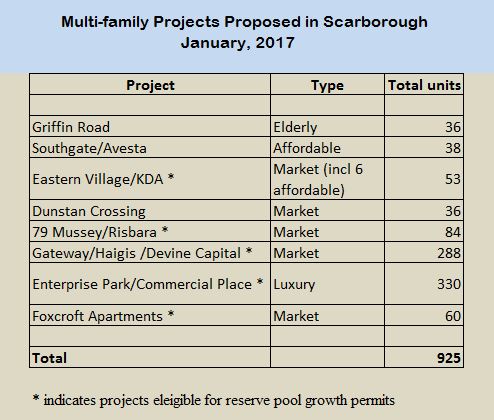
los-mf-units-01-2017But our review of all available data reveals that the actual total number of new apartment units currently “on the radar” is 925.  Now it is true that all of these units may not be built.  And the timing of the building could stretch over a couple of years.  But 925 additional units is a 150% increase in multifamily rental units over the existing base of about 600.  By any standard, this is a staggering increase and one that should get careful analysis and – dare we say it – public input.

Here’s a summary of the estimated number of multi-family rental units as of 2015 and the number of units that may be built based upon the Council’s recent approval of additional growth permits:

los-mf-unit-chart


Public opinion?  What public opinion?

Those of us who try to keep up with the goings-on at Town Hall have seen this movie more than once before.  The entire process of approving the massive increase in rental units was on the low-visibility fast-track.  This is an all-too-familiar approach for a Town Council that likes to crow about transparency as one of its core values.

Recall that the apartment surge proposal first popped up at a Council workshop in mid-December.  And then was referred to the Long Range Planning Committee that discussed it at a meeting on January 6 — a meeting that was not listed on the calendar of meetings on the Town website.  Finally, the Council gave its first and final approval to the “growth permits” on January 18, despite a number of public comments and emails arguing that the process was moving much too fast for such a significant change in the Town’s residential character and that the tax implications of the decision were not well understood.

Once again, we have a situation where public involvement on an important Town decision was minimized.

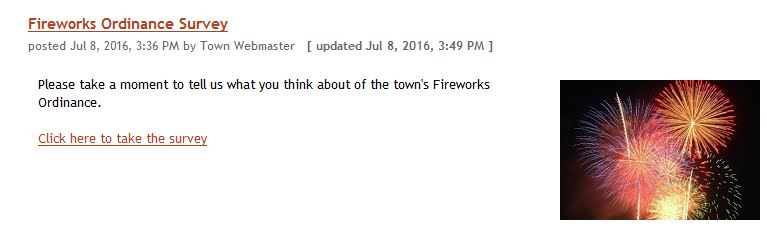
Isn’t it strange that the Town leaders could devote the time and energy to a public survey of our attitude on the fireworks ordinance this past summer, but couldn’t bring themselves to have a full and open discussion of a decision that could have a major financial and quality of life impact on the Town?  Even a web survey would have added greatly to the public input on this important question.

los-fireworks-survey

Notice of the web survey on possible changes to the fireworks ordinance that appeared on the Town’s website this past summer.

It kind of makes one wonder… why the big hurry on approving the apartment surge?


An inconvenient question

There has been a deafening public silence from the School Department about the impact on the schools of a major surge in enrollment.  Why so quiet?  Perhaps it’s because of the significant  implications for both the operating and capital budgets of a sudden bump in the student population…  Apparently the strategy is “the less said, the better.”

Here’s just one of the many questions that could reasonably be asked of the School Department…  Let’s assume the new apartments result in the high-end estimate of new students that Council Chair Babine has heard – 187 kids.  And let’s also assume 60 or so of those kids are clustered in the Middle School grades of 6 to 8, an assumption that’s clearly within the realm of possibility.

If these numbers occurred, what would be the impact on the Middle School?  For this discussion, let’s ignore the potentially significant additional operating expenses associated with such a population increase and focus just on the Middle School building capacity.

The December 15, 2016 update of the schools’ Long Range Facilities Master Plan notes that the Middle School currently “is very overcrowded by any standards for its 714 students”  (p. 6).  So would the sudden, unexpected enrollment increase create an overcrowding emergency at the Middle School – just the sort of situation the “Growth Ordinance” was designed to avoid?

los-ms-meterv4

If the enrollment surge triggers an urgent need to expand/renovate the Middle School, we could soon be confronting an accelerated timetable for the $18 million project Middle School project outlined in the Facilities Master Plan.  (And don’t forget the $51.8 million primary school consolidation project that’s also being discussed.)

With this magnitude of school capital projects on the horizon, wouldn’t it be prudent to understand the impact of an enrollment surge on the timing and amounts of school capital expenditures?  Unfortunately, a majority of Council members don’t share this view.  After all, it’s only taxpayers’ money.


What’s really going on here?

los-dollar-signsMake no mistake about it – developing 850 (or 925) apartment units is big business.  At a market value of $125,000 each, 850 units equates to about $106 million of real estate development value.  This is not just another donut shop coming to town; we’re talking serious bucks here.  So there’s a long line of developers, contractors, bankers and lawyers who have a keen financial interest in making these apartment projects happen.  So far, it looks like the financial interests of those well-heeled developers are running roughshod over the interests of us poor, beleaguered taxpayers.

Last Wednesday’s Council action left one huge open question… is there a limit on the number of apartment units that can be built in Scarborough?  At this point, we don’t think there is a limit.

What will happen when a developer comes along next month with plans for a gleaming 300-unit multi-family apartment complex?  And another developer shows up in March with an awesome 400-unit project?  Apparently all they have to do is ask the Council for additional growth permits,  And won’t the Council have a difficult time rejecting those requests, given its complete lack of guidelines for approving such requests?

Of course, all of these requests — including those just approved — should have been evaluated in conjunction with the Town’s Comprehensive Plan.  But that plan (from 2006) is currently being updated.  So rather than wait for a thoughtful, data-driven plan completed with significant public input, the majority of Council members decided to wing it with respect to how the Town will grow.  And this, dear reader, is how in 2017 real estate developers became the driving force in setting Scarborough’s residential character.


Well, friends, that’s it for now. 

We hope to get our version of the 10-year Scarborough capital plan out in the next blog.  And another budget season is just starting.  It should be an interesting one,  especially given the expense increases that are already built into the school budget.  We’ll make sure you get the full scoop!

Happy trails until we meet again!

Be neighborly,

TT Hannah


los-sniff-test-hdr-v3

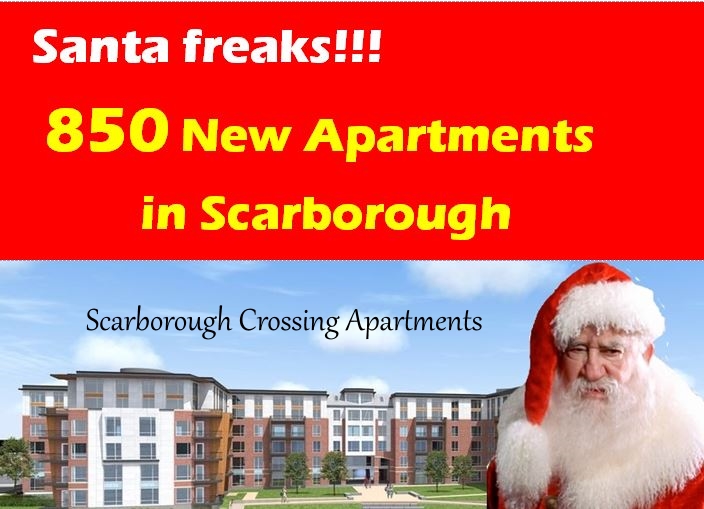
850 New Apartments in Scarborough

los-santa-and-apts-v2

Let’s face it… 2016 has been a horrible year for Santa Claus.  First in March there was that hefty fine from OSHA for supplying hazardous workplace clothing (those pointy elf shoes).  Then in August the EPA cited him for unlicensed biological material discharges (reindeer droppings).  And on top of this, the Jolly Old Elf attends the Scarborough Town Council workshop on “Growth Management” on December 14 and learns that there are 850 new apartment units in the pipeline for construction in Scarborough. 

“I have capacity limits, too, you know,” Santa told LookOutScarborough over a post-workshop Margarita at El Rayo. “How am I supposed to handle that kind of growth? There are only so many visits I can make in that one night, you know,” he huffed.

We feel Santa’s pain.  Adding 850 apartment units in more or less one fell swoop seems like it could have major consequences to the Town — many of them not good.  Before we get into the issues, here’s some key background info:

Background information you need to know

Existing households – According to Census data estimated through 2015, Scarborough currently has about 7,500 households.  So adding 850 households over the next couple of years will be more than a 10% increase.

Proposed projects – Here’s a breakdown of the projects that are currently envisioned (though all have not been approved):

los-new-apts

Housing construction ordinance – In response to a rapid increase in single-family home building in 2000-2002, the Town Council enacted an ordinance to limit new home construction.  This limit was necessary since the new construction was causing significant school enrollment increases, which put great pressure on school staff, facilities and costs.  For more than ten years, there has been an annual limit of 135 permits being issued for new homes. 

There is also a “reserve pool” of permits for “special projects” – which can include projects “that aren’t easily accommodated within the annual allocation [of 135 units].”  Presumably the two large projects noted above (Enterprise Business Park and Gateway/Haigis Parkway) would use “reserve pool” permits.  There are currently only 215 permits in the reserve pool — not enough to allow both projects to proceed.  The current ordinance requires Town Council action to replenish the number of reserve pool permits once it is exhausted.  Which is why this discussion is taking place.

Recent housing construction activity – Due largely to the extended recession, annual demand for new single-family home building permits has been well under the annual cap of 135 for the past eight years.  As can be seen in the chart above, the first five projects are each modestly-sized apartment developments.  These are now economically viable projects based on market demand and financing availability, at least as far as the developers are concerned. The last two projects on the list are horses of a different color, certainly in terms of size and potential community impact.


Potential Impacts

los-gateway-commons

So what are the potential community impacts of adding 850 apartment units to Scarborough’s housing stock?

Tax rate impactThe impact on the tax rate is not at all clear.  The main variable that will impact taxes is how many new kids will attend Scarborough schools from the added apartments.  The average per pupil expenditure in the Scarborough schools is $13,263, according to the latest data from the Maine Department of Education.  How much additional tax revenue will each of these projects generate and how will that compare to additional school costs?

The material presented at the workshop concerning the likely tax impact was extremely general, anecdotal or outdated.  A much more thorough analysis of the tax impact of this major expansion of the Town’s housing stock is definitely needed.

Quality of life impact – For the sake of argument, let’s say each new apartment brings an average of 1.5 new residents to Scarborough.  That’s nearly 1,300 new residents added to the current population of just about 20,000.  How much more traffic will that generate?  How much more congested will Oak Hill and Dunstan Corner become, especially during the summer?  (And, no, better bike paths are not the answer.)

Apartments by their very nature tend to have residents who remain in the community for shorter periods than homeowners.  As a Town that highly values its close-knit neighborhoods, what will a large influx of apartment units do to the stability and fabric of Scarborough’s neighborhood-based community?


Here we grow again!

los-fastest-growing

The first words on the Town’s website are: “One of the fastest growing communities in Maine…”  Adding 850 housing units will certainly help make that boast true going forward.  But is being fast-growing what Scarborough residents want?  How is “fast-growing” defined?  And what are the real-world impacts of being fast growing?

The theme of last week’s workshop, as set by the Town Manager and his staff, seemed to be: “here’s what we have to do to make these apartment developments happen.”  Perhaps a better theme would have been: “what are all the implications of these developments and do we really want them to happen?”

Let’s hope the Town Council…

(1) demands adequate data about the impact of the proposed developments,

(2) provides the public with a comprehensive and understandable analysis of the potential impacts, and

(3) solicits meaningful public input on the future of housing expansion in Scarborough.


Timing is Everything

los-timing

The discussion of a major increase in housing growth in the Town would seem like a critical one for our future. Yet here we are with the Town Council discussing this matter during the holiday season when the least public attention is likely to be paid to it.  We hope that the larger issues associated with rapid growth will get a full public airing before piece-meal decisions are made on individual apartment projects.


That’s all for now. 

More good stuff is coming in the New Year.  Like a review of the Town’s and Schools’ financial results for Fiscal 2016.  And our exclusive predictions of the  major capital projects that are in Scarborough taxpayers’ future.  Stay tuned!

In the meantime, Merry Christmas and Happy New Year!

TT Hannah


New Teachers’ Contract — Such a Deal!

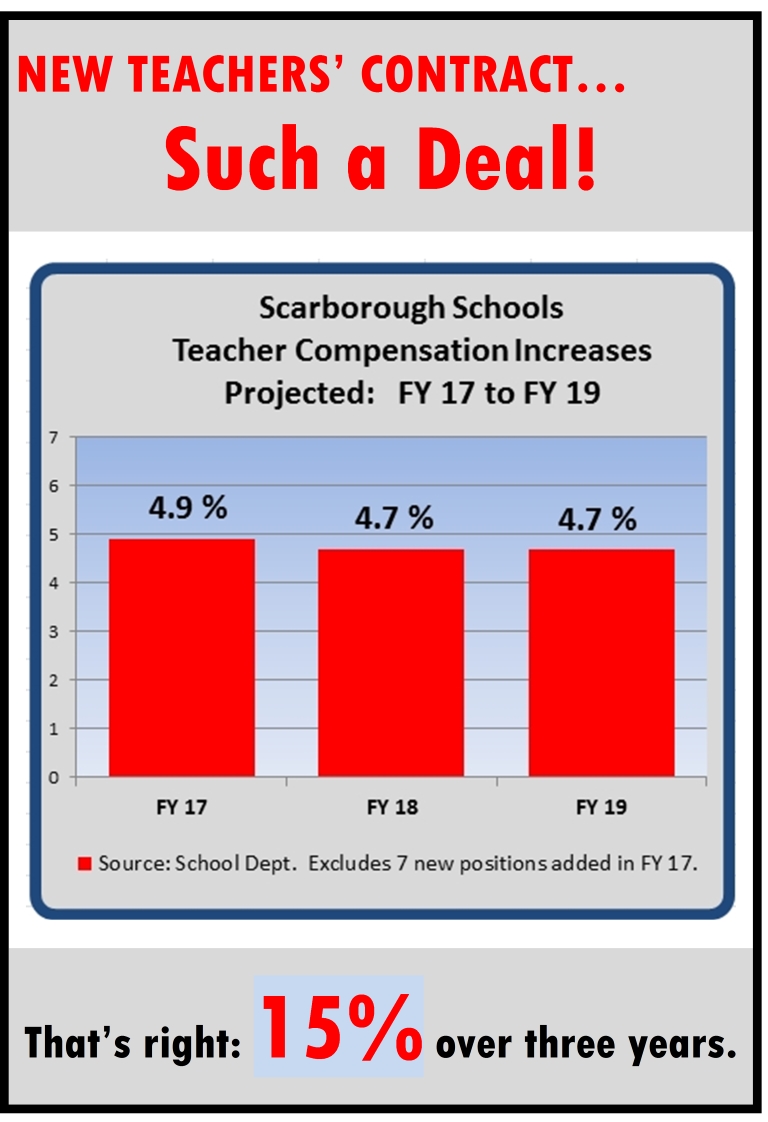
los-tchr-sal-incr-fy17-19-v2

Sometimes, writing this blog can be a difficult task.  Other times – when the subject is so startling and easily understood – it can be easy.  This one was like falling off a log…

At the School Board meeting on October 20, Superintendent Kukenberger gave the promised analysis of the newly-approved teachers’ contract for Fiscal 2017 through 2019.  Let’s start on a positive note by commending the superintendent for providing a thorough, understandable analysis.  It was one of the best financial reports we’ve seen from the School Department.

The details of the contract, however, are disturbing.  As noted above, the total projected compensation costs of the teachers’ contract were an increase of 4.9% in the first year, a further increase of 4.7% in the second year and an additional increase of 4.7% in the final year.  Compounding those increases results in a total increase in teacher salaries and benefits of 15% over the three-year period.   [Arithmetic note: if you just add the three annual increase percentages, the total is 14.3%.  But since the increases are cumulative, it is more accurate to compound the three annual increases resulting in the 15.0% increase.]

We can’t help but wonder…  how many Scarborough taxpayers are expecting a 15% increase in their incomes over the next three years.


What this means for the school budget

In the current fiscal year, total teachers’ compensation accounts for about 48% of the total school expense operating budget.  Yes, this single contract governs 48% of total school expenses.  And will for the two years after this, too. 

Salaries and wages of other employees account for another 27% of total expenses, most of which are also governed by union contracts.  Then there are debt service expenses that are “locked in” as a function of borrowing for past capital projects (like the Wentworth School) and equipment. 

los-fy-exp-breakdown-by-type

All of which suggest that overall expense growth may approach 5% next budget yearin an environment of very low inflation and flat to modestly declining enrollments.  So do not be surprised when the FY 2018 budget starts out with a “level services” budget with an increase of between 4.0% and 5.0% — just to keep the existing programs in place.

Please don’t buy it at budget time if you hear salary and benefit costs described as “fixed” or “uncontrollable.”  They were indeed very controllable through the negotiation of the union contracts.  In the case of the recent teachers’ contract, however, the opportunity to rein in compensation costs was missed.  And we will pay the price this year and for the next two years.

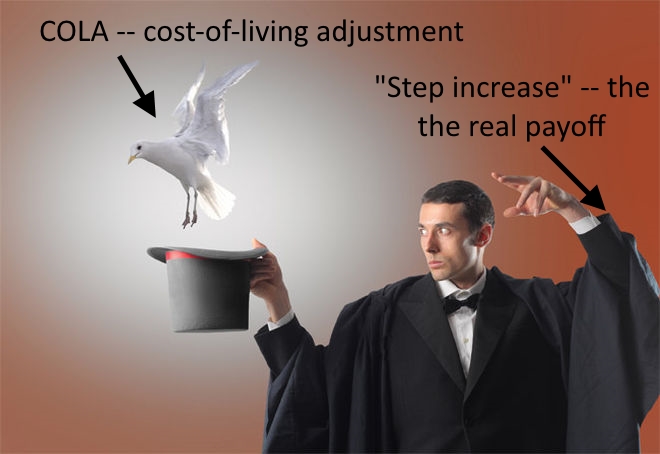
Another note of caution: In discussions about the contract, you will likely hear emphasis on the modest cost-of-living adjustments or COLA in the contract – 0.5% in year one, 1.0% in year two and 1.5% in year three.  (These were corrected from the COLAs announced at the October 6 School Board meeting.)  Sounds reasonable enough, right? 

los-magician-dove-hat-v2

But then you may also hear something about “step increases.”  These are the other and far larger component of pay increases.  They are given every year and depend upon the teacher’s years of experience and education level.  In the past, the impact of the step increases has been glossed over despite the fact that they are the most significant portion of a teacher’s salary increase.  As noted in our April 20, 2015 posting, individual teacher salary increases were in the 2.5% to 7.5% per year range in FY 2016 once the step increases were included.  The COLA amount is a diversion; the step increases drive total teacher pay.


Was this contract really “negotiated?”

los-negotiations

We have always understood “negotiating” to mean the give and take process between two or more parties – each with their own interests, viewpoints and needs – to arrive at an agreement to resolve an issue of common concern. 

We’re not at all sure that much negotiating took place on this contract.  Here are three reasons that suggest it was a rather laid-back negotiating process, at least where taxpayers’ interests were concerned:

  • In the public discussions of the negotiations after the contract was signed, we never heard any mention of what the School Board’s financial goals were going into the process.  And we can’t recall hearing the teachers’ deal being called a fiscally prudent deal for taxpayers.
  • It was announced that the School Board accepted the union-proposed list of school districts to be used for salary comparisons. Presumably the union came up with the districts with the highest salaries that they could justify (like Falmouth and Yarmouth).  And we went along with it.  In most negotiating situations, one would expect the other party (i.e., the School Board) to come back with a list of comparable districts with lower salary structures.  And then meet in the middle.  Also known as compromise.
  • The results of the negotiations appear very one-sided. The union got three annual compensation increases of nearly 5% per year (at a time when inflation is in the 1.0% to 1.5% range), six salary steps added for teachers at the current top of the salary scale, retention of the 80% health insurance premium contribution and six additional paid hours for each teacher per year.  And the School Board got… er, um, well, hmm… very happy teachers.  (Perhaps even ecstatic teachers.)

In summary, we’re wondering just who in the negotiations was considering the financial impact the contract would have on Scarborough’s taxpayers.  We do, after all, pay the bills.

We're guessing the union sprang for the champagne at the wrap-up meeting.

We’re guessing the union sprang for the champagne at the wrap-up meeting.


Was a nearly 5% per year increase necessary?

los-revolving-doorThe primary argument justifying the salary increases was the need for Scarborough to remain (or become) competitive with other school districts in the area.  Then the union selected the districts to which we should be compared and found us woefully lacking.

So if our salary scale is so low compared to surrounding communities, we must be losing teachers in droves, right?  Well, apparently not.  The superintendent’s report on the teachers’ contract noted that 61% of the current Scarborough teachers have been here for 16 or more years.  And that teacher turnover last year for reasons other than retirement – which can include a number of reasons besides getting a higher paid position elsewhere – was 5.6%. 

Those statistics don’t exactly suggest a groundswell of teacher dissatisfaction with the school system or its pay scales.  Nor do they appear to support the need for a 15% compensation increase over three years.


See for yourself!

Once again, we find ourselves potentially in the unenviable position of being labeled anti-something.  Anti-teacher or anti-student.   In fact, we are very supportive of the fine group of teachers that continue to provide a very high quality education for Scarborough’s students.   At the same time, we are supportive of the financial concerns of all Scarborough taxpayers.  Not just retirees on fixed incomes.  But also families with kids.  And single folks.  All of us are impacted by tax rates that significantly exceed inflation.

There’s no question that the teachers deserved a pay increase.  The only question is: how much?  Would 3% have been reasonable?  Did the School Board have a total increase target  before entering the negotiations or was it a money-is-no-object strategy?

We do understand that the School Board’s responsibility is first and foremost to the students.  But the taxpayers of the community deserve some consideration, too.

los-what-a-deal

Did we get that consideration in a contract that increased total teacher compensation by 15% over three years?  We don’t think so.  But at least one School Board member thought otherwise, enthusing about the contract that “we’re getting a deal.”   Some taxpayers question the type of “deal” we got.

Please don’t take our word for any of this.  Check out the video of last Thursday’s School Board meeting  on Scarborough Community TV.  The superintendent’s presentation begins at about 19:30 on the video and the School Board discussion starts at about 01:03:45.

Such a deal, indeed!


 VOTE NOW

Just another reminder that early voting is happening now at Town Hall.  (The schedule is in the last blog.)  If you have already voted, thank you!

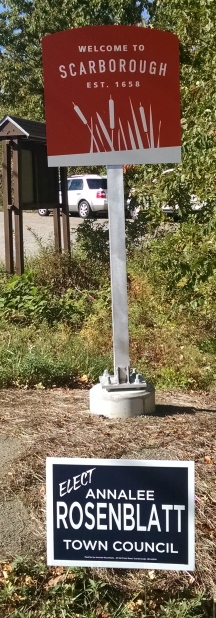
azr-sign-pumpkinsPlease consider voting for Annalee Rosenblatt for Town Council.  A labor negotiator by profession, she has lived in Scarborough for more than 30 years. She will be a strong voice for fiscal prudence in Town affairs.  Her impressive record of public service and her positions on many issues are at her website: www.AnnaleeForCouncil.com.  Please check it out.


That’s it for now, folks.  More excitement is sure to follow!  

Happy trails until we meet again. 

Be neighborly,

TT Hannah

Disclaimer:  The opinions expressed in this blog, as well as any forward-looking assumptions or projections, are solely those of the author.

los-tchr-sal-incr-fy17-19-v2

Another Beachfront Give-away?

los-pp-final-w-title

This past Saturday morning (October 15) more than 50 Pine Pointers gathered at 9am at the local fire station for an update on the proposed Avenue 2 land deal.  Council Chair Donovan – performing without a net – was the featured speaker.  To say that the crowd was uneasy about the proposed deal and the manner in which it is being handled would be a colossal understatement.  Pine Pointers, you probably know, are a bit sensitive about land transactions, given the Lighthouse Motel deal and other past deals.

There’s no doubt that Avenue 2 situation is a complicated one.  But it’s an important one to understand if you care about how the Town does business and how it considers the interests of its citizens.

In our never-ending quest to distill complicated matters down to their understandable essence, we offer this plain-English account of the basic issue of the current Avenue 2 controversy…

What’s a “paper street”?

The current path along Avenue Two.

The current path along Avenue 2.

Believe it or not, the Avenue 2 saga begins in the 1870s when the first developments on Pine Point were laid out and mapped.  At that time, streets were sketched out along with the house lots.  Over time, however, portions of the envisioned streets were never built and accepted by the Town.  They became “paper streets” – lines on maps where real streets had once been planned.  In some cases they became vacant lots; in the case of the Avenue 2 Extension, it became a bucolic and well-used pathway to Pine Point Beach.

As years rolled by, ownership of these paper streets became messy.  Who owned them?  The Town, the original developer or adjacent property owners?   As properties changed hands over the years, the ownership trail of the paper streets often became murkier.

Finally, in 1975 Maine enacted legislation designed to unravel the paper street ownership issues. A key element of that legislation was that each municipality had to take steps to maintain the city or town’s ownership interest of the paper streets by September, 1997.  If they failed to do that, the ownership of the paper street would go to the abutting lot owners on each side of the street – with each abutter getting the half of the street adjacent to his or her property.

One of the major questions in this matter is whether Scarborough did take the steps called for in State law by September, 1997 to protect its ownership interest in its paper streets.

So what’s at issue here?

The following is the plot plan of the parcel in question from the Town’s tax assessing data base:

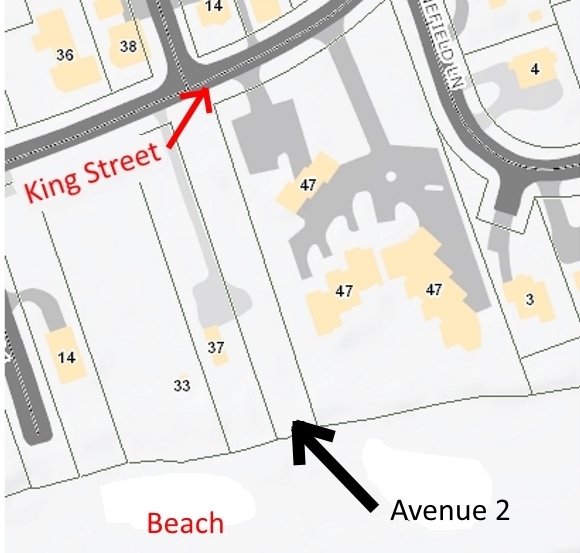
los-pp-plot-plan-v3

The long, skinny parcel labeled “37” is 37 King Street, which Charles Gendron purchased in 2013 for just over $800,000.  It is a 50-foot wide parcel.  The parcel at the right labeled “47” is 47 King Street, the Gables by the Sea condos. 

In between the two labeled parcels is another long, skinny parcel without a number.  This parcel, also 50 feet wide, is the Avenue 2 Extension – the paper street that is the source of the current uproar.

Mr. Gendron’s lawyer contends that the Town lost its ownership rights under the 1975 Maine law by not acting to preserve its interest in the Avenue 2 Extension by September, 1997.  Since the Town Council did not act, according to Gendron’s lawyer, his client owns to the middle of the Avenue 2 Extension.  Gendron is asking the Town to confirm his ownership of his side of Avenue 2 in exchange for an agreement (easement) to allow permanent public access from King Street to the beach over Avenue 2.

If the Town Council indeed failed to act in accordance with State law on this matter back in 1997, it was a major oops that could have serious impact on public beach access not only on Avenue 2 but on several other paper streets in Scarborough.

Why the big deal over a 50 foot strip of land?

Pine Point Beach looking west from Avenue Two.

Pine Point Beach looking west from Avenue 2.

Well, from the Town’s perspective it’s certainly important to protect beach and shore access wherever it currently exists.  The pressure to restrict access is always there.

And there’s also the “process thing” – is the Town’s business being done in an open, transparent manner?  It’s clear that Mr. Gendron has the ear of the Town Manager and Council Chair Donovan, presumably just as any of us would have. We’re not suggesting anything inappropriate about that. 

On the other hand, a large group of Pine Point residents have numerous unanswered questions about the Avenue 2 proposal.  They have been asking for a Town Council workshop session on this issue for months in an attempt to get all the facts out on the table.  So far, they’ve had no success.  Yes, Chairman Donovan has addressed the Pine Point community twice, but he is only one member of a seven-person Council.  Also, when and if a workshop is scheduled, it will likely be this winter when a large number of the summer residents (who are year-round taxpayers) will be in a more southerly latitude.

From Mr. Gendron’s point of view, the 25 feet of Avenue 2 he is claiming (half of the 50 foot wide paper street) will make a huge difference in the house he will be able to build to replace the humble A-frame that’s currently on the lot.  A building on this site must have a 15-foot setback from the property lines.  So if the newly constructed house were to be on his existing 50-foot wide lot at 37 King Street, the maximum width of the house could only be 20 feet, that is, 50 feet less a 15-foot setback on each side of the property.

But if he adds 25 feet of Avenue 2 to his lot width, it will bring the overall lot width to 75 feet.  Taking off a 15-foot setback on each side of the lot would allow for a maximum house width of 45 feet.  So the maximum width of the house jumps from 20 feet to 45 feet – the difference between a modest dwelling and a much more expansive one.  (Sorry about all the arithmetic!)

The following image shows the current house at 37 King Street and an imagined replacement with the 25-foot larger lot.  Note that the “after” image is not to scale and grossly overstates (we hope) what zoning requirements would allow.  Its purpose is to suggest that the inclusion of the Avenue 2 area in the 37 King Street lot significantly increases the amount of ocean-facing area available for a replacement house.

los-pp-before-after

Just for the record we should also note that a 50-foot lot along this part of Pine Point Beach would have a tax assessment value of more than $1.0 million.

It’s what developers do

We don’t know Mr. Gendron.  We do know he already owns a home at 17 King Street at Pine Point.  And we know he’s a successful real estate developer.  So to him the Avenue 2 project is likely just a routine real estate development –  (1) buying an undervalued piece of property (37 King Street), (2) investing some money in it (the legal fees to take advantage of a possible Town screw-up on Avenue 2 and the cost of building a much larger and nicer house to replace the A-frame) and (3) ultimately selling it for a bundle.   

As far as we can tell, there’s nothing at all shady about this from a purely business perspective.  Or any other perspective, for that matter.  Sure, he’s not making himself popular with quite a few of his neighbors, but that’s a known occupational hazard for real estate developers.

The Issues

There are a host of issues that are tangled up in the current controversy – including ownership, easements, tax implications.  As evidence of that, we cite the 16-page legal analysis done by Mr. Gendron’s attorney and the long list of unanswered questions from the Pine Point residents’ group.  We hope the above discussion has clarified the basic underlying issue.  But this matter is likely to rage on for months unless all the real issues are untangled and presented in a manner that your average non-lawyer can understand.  Here are a few of the basic questions we hope the Town Council will answer:

  • Exactly what is Mr. Gendron proposing? The only thing we have seen in writing is that he is proposing a swap of clear title to his half of Avenue 2 for a permanent public access easement to the beach.  But it is clear that relocating the existing path is somehow part of the proposal.  What is the purpose of relocating the path and why isn’t that part of the written proposal?  Also, Councilor Donovan noted that Mr. Gendron’s building plans will not include any building extending into the current Avenue 2 lot.  Is that documented as part of Mr. Gendron’s proposal?
  • What’s in the proposed deal for the Town?  Mr. Gendron appears to get the ability to build a much more valuable house on the lot if the Town confirms his ownership of half of Avenue 2.  What value does the Town receive in the deal?
  • Did the Town fail to take action that would have protected its interest in Avenue 2 and other parcels by the September, 1997 deadline set by Maine law? Shouldn’t this issue be reviewed by an independent party?  In fact, it appears that the Town’s legal response to the Gendron proposal has been muted at best.
  • What is the status of the Town’s other paper streets and how will any action on Mr. Gendron’s proposal affect them?

We hope to see you soon at a Town Council workshop on the Avenue 2 land deal!


In other news…

The Town Council meeting on October 19 included an item on the formation of a building committee for a new public safety building.  Taxpayers will want to pay careful attention to this project… starting now.

The School Board meeting on October 20 will include a report on the details and financial impact of the recently signed contract with the teachers’ union.  Look for a report in the next blog posting.

azr-sign-waterEarly Voting Now!

Also, please don’t forget that early voting is happening now at Town Hall.  And Annalee Rosenblatt, a long-time advocate for reasonable real estate taxes, is running for Town Council.  Please take a look at her website for a full list of her impressive experience and qualifications.

The website also includes a calendar of early voting days.

Please vote for Annalee!  She’ll be a great representative for all Scarborough residents!


Happy trails until we meet again!

TT Hannah


los-pp-final-w-title

Teachers’ Contract Signed… just send us the bill…

los-blank-check-1

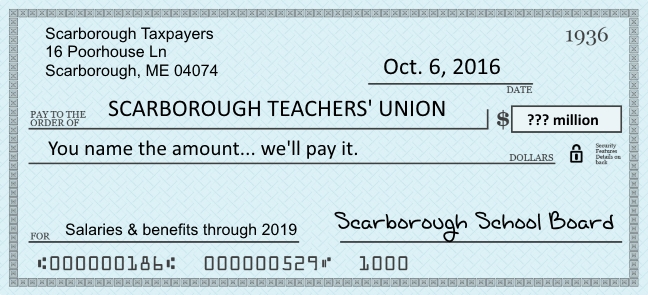
Well, friends, it didn’t take long to get back into the swing of things after the summer doldrums.  At their October 6 meeting, the School Board approved a new three-year deal with the teachers’ union.  Remember, this contract probably accounts for 40% or more of total school expenses.

We wish we could tell you how much the new contract is going to cost you, but we can’t.  Frankly – and frighteningly — we’re not sure anyone really knows what the total cost of the new contract is.

The cost information wasn’t disclosed at the meeting.  If the Board members had it, they weren’t sharing it with the public.  But we were promised that cost information will be developed by the Superintendent and presented at the next School Board meeting.   Wait, what… the cost of the contract is going to be developed and shared after the School Board unanimously approved it?  That’s weird; in that old-fashioned world we live in, you find out how much something costs before you agree to buy it.   Did we miss a paradigm shift?

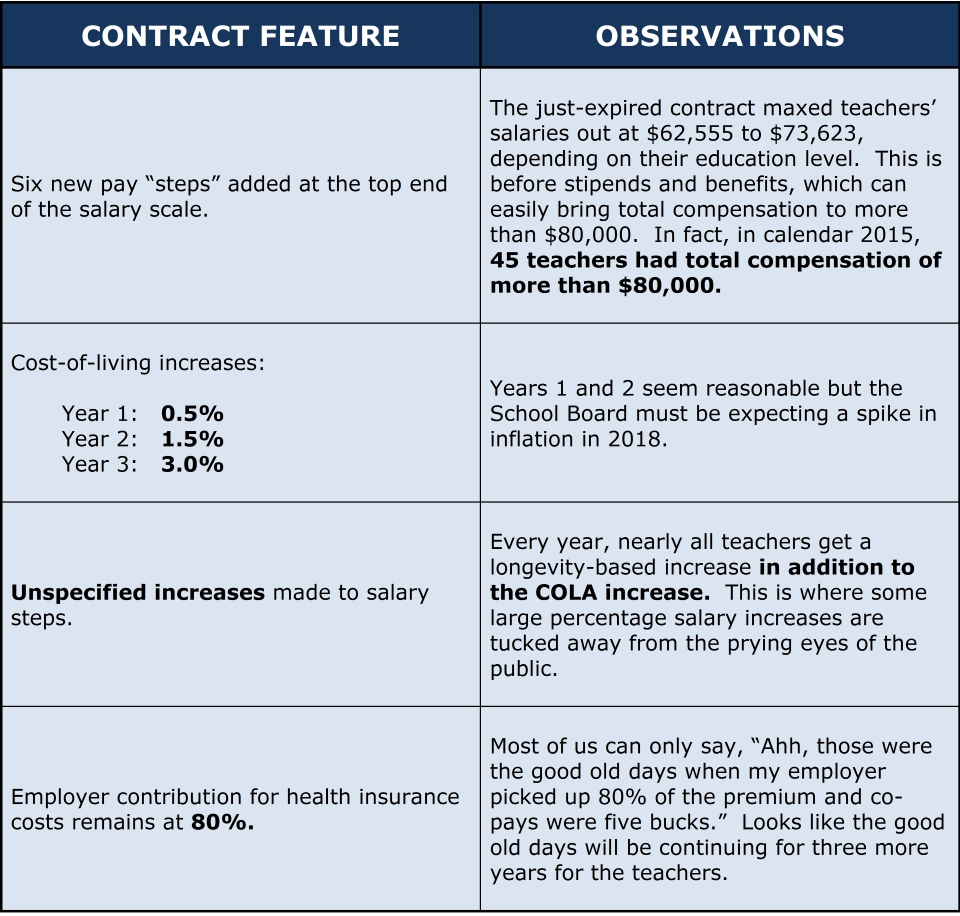
So here are a few of the contract details that were unveiled at the School Board meeting:

los-tchrs-k-features

Again, no costs were mentioned for any of these items.  Anyone want to hazard a guess as to the amount of increase these measures will mean for the “level services” budget over the next three years?


Schools end year with $2 mil surplus – Wentworth Windfall, Part 2

los-elephant-ww-2Also announced at the October 6 School Board meeting were the preliminary financial results for fiscal year 2016, which ended on June 30.  Turns out it was a good year financially… the schools ended the year with a surplus (or fund balance) of $1,960,000 Revenues were more or less as budgeted, but expenses were favorable by about $2.2 million.

Usually the schools come in with a favorable expense budget variance in the $400,000 to $500,000 range, but this year it was significantly more.  The main reason – our old friend the Wentworth Windfall!  Will it ever go away? 

[Skip this paragraph if you don’t care about the gory details of the Wentworth Windfall:  The Windfall originated when the Town mistakenly borrowed $ 2.6 million too much to pay for the Wentworth School construction. That excess is being applied to regularly scheduled debt service payments in two parts: (1) The current year budget (Fiscal 2017) includes $1.6 million of the Windfall being applied to regularly scheduled debt service payments.  (2) In Fiscal 2016 (just completed), we also applied about $1.0 million of the excess borrowed funds to regularly scheduled debt service payments.  This amount had not been budgeted in Fiscal 2016 so it appears as a favorable expense variance.]

los-available-balBottom line… we taxpayers have already ponied up about $2 million of tax revenue which is available to pay for the coming year’s school budget.  So when the Fiscal 2018 discussions start early next year, don’t forget we’ve already got $2 million in the pot.  Perhaps taxpayer funding can be flat for Fiscal 2018 since we’ve already anted up $2 million with the Wentworth Windfall. 


Enrollment update!

Okay, we admit it.  We felt a slight tingle of hopefulness when new superintendent Julie Kukenberger announced the October 1 enrollment numbers at the School Board meeting.  It wasn’t the numbers themselves… it was just the fact that the superintendent was voluntarily informing the public about a key school department statistic.  We hope this was a small inkling of transparencies yet to come.  That would be a most welcome change.

The numbers themselves are fairly unremarkable as the following chart indicates:

los-enrollment-2013-17

So, instead of the growth in enrollment Dr. Entwistle assured us was occurring in Fiscal 2016, we actually lost a handful of students.  Not a big deal from a financial perspective, but it does make us wonder – with the strong housing market Scarborough has experienced in the last year, why is enrollment not increasing at least somewhat?  (And, no, we’re not suggesting that the enrollment projection study done last year be revised and updated.)

Here’s hoping that there will be periodic enrollment updates in the future.  And that the new super will bring a new level of transparency to the school department.


School lunch program

Following is an excerpt from current Scarborough High School lunch menu.  Click here for the full month’s menu.

los-schl-lunch-menu

Hey! Where’s the kale???  Must be in the Salad Bar.

Faithful readers of this blog may recall that the budgeting of the school nutrition program has been a burr under your editor’s saddle for quite some time.  The school lunch program routinely loses more than $200,000 each year.  Yet every year school administration puts forth a budgeted loss of only $25,000 or so.  Every year there is a new, hopeful story – never substantiated by realistic assumptions – of how the program is going to turn around financially.  But it never does.

los-veggie-poodlesThe just-ended fiscal year was no different: You, dear taxpayer, were told in the budget that the school lunch program was going to require $25,000 of taxpayer funding.  When the books were closed on the year, however, you ended up funding a loss of $237,000.  We sincerely hope this charade will not continue and that the Fiscal 2018 school nutrition budget will provide an honest and realistic assessment of the program’s revenues and expenses.  Now that would be refreshing.


>>>>>>>>>> Election Season Update <<<<<<<<<<<

School Board:

The two members whose terms are expiring are running – unopposed – for re-election.  Nuf said.

azr-sign-01Town Council: 

There are four candidates for the two seats that are up for grabs.  For our money, Annalee Rosenblatt is a no-brainer for one seat.  Annalee has lived in Scarborough for more than 30 years.  Her record of public service to the Town during that period is unparalleled. She served two terms on the School Board, including one year as Board chair.  In addition, she is a long-time member and past chair of the Kiwanis Club and served as the chair of the Scarborough 350 Committee in 2008.

As a professional labor negotiator, Annalee has business skills which will be a significant asset to the Town, especially at budget time.  She was one of the charter members of SMARTaxes (Scarborough Maine Advocates for Reasonable Taxes). 

Annalee is someone we can count on to represent ALL Scarborough taxpayers.  Please take a look at Annalee’s website (click here),  review her extensive qualifications and give her your vote.


Early voting has started! 

Vote today at Town Hall.  It’s quick and easy!

los-vote-cal-11-16


That’s all for now, folks.  More excitement will surely follow.  Breaking news as it happens.

Be neighborly,

TT Hannah

[Please note that the views expressed in this blog are solely those of the author.]


los-blank-check-1

Summer Swelter: Beach News & Teachers’ Contract

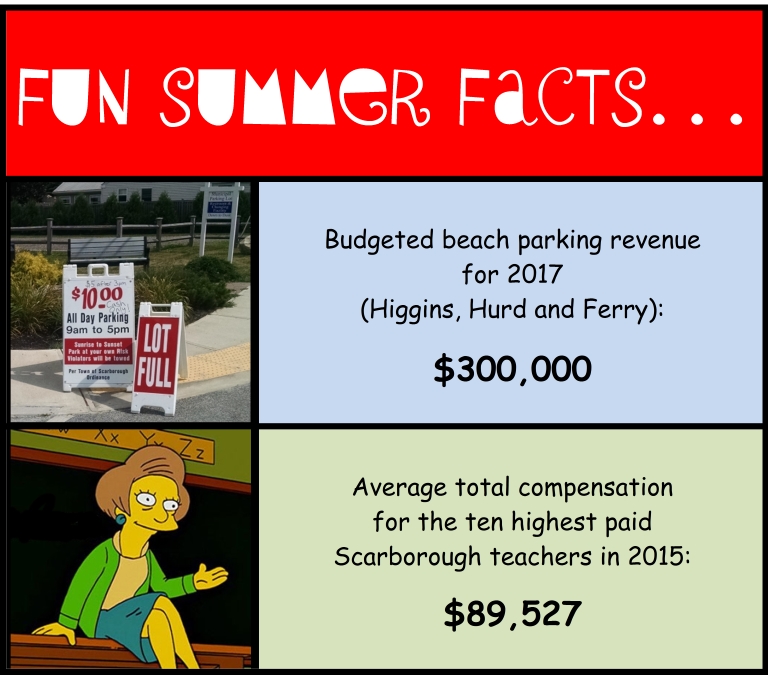
los-fun summer facts

Ahh, those lazy, hazy, crazy days of summer!  What a summer it has been!  Now seems like a perfect time for an update on the goings-on at Scarborough’s fantastic beaches.  Part 1 of our beach report follows.

And perhaps surprisingly, this is also a perfect time to highlight the school budget.  How can that be, you may well ask?  It’s the middle of the summer and the planning for next year’s school budget won’t start for months.  No one is paying attention to the school budget.  And that, friends, is the fatal flaw.  Please read on and discover why these dog days of summer are in fact the most critical time for the school budget.

But first, let’s see what’s happening at Higgins Beach this summer…

Higgins Beach where the livin’ is easy… and heavily-policed

los-higgins setup 08-02-16

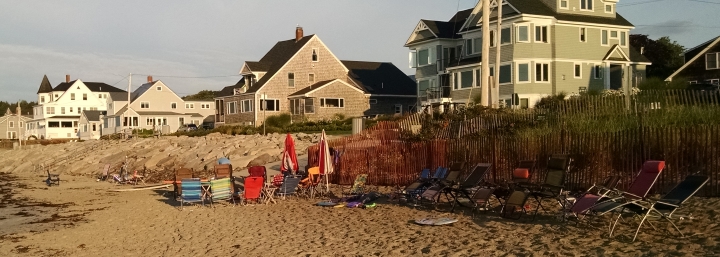
By 6am, the prime spots at Higgins have been staked out for the day.

As far as police presence is concerned, Higgins Beach must be the safest place in all of Scarborough.  From about 5am until 10pm, you’ll almost always find one of the men or women in blue on site at Higgins.  Sometimes two of them and, now and then, even three officers.  Granted, they’re not all fully decked-out officers in blue-lighted vehicles, but they’re all hooked into the police command center back on Route 1.

It appears that the Higgins Beach neighborhood is even better protected than Prouts Neck.  And the good folks down there at the end of Black Point Road actually pay for a summer police detail.

los-hb-the wiggleSo what accounts for this heavy police presence at Higgins?  We don’t know for sure, but here’s our guess.  As you may recall, last year’s Higgins neighborhood brouhaha concerned those darned surfers who allegedly (1) woke people up early in the morning slamming their car/van doors, (2) threatened public decency by changing into and out of their wetsuits shielded only by a towel and (3) wantonly urinated all over the place.

Scarborough’s First Parking Meter

los-higgins pkg mtr.v2The solution to this was the installation of the Town’s first ever parking meter.  It doesn’t cost anything to park (currently), but you need to punch in your license plate number, print out a ticket (which has the time and date on it) and place it on your dashboard.  Then a parking officer can check the time on the ticket and enforce the one-hour limit  on Bayview Avenue parking.

Unfortunately for the anti-fun crowd that led last summer’s campaign against the surfers, the parking meter solution hasn’t been fully effective.   Many surfers continue to use the metered Bayview Avenue spaces while adhering to the one-hour metered limit.  So look for a new effort next year to do away with the parking spaces on Bayview Avenue.  Or some other method of eliminating surfing altogether.  Watch the Ordinance Committee to see what approach the group trying to privatize Higgins Beach will try next.

Beach Vigilantes on Patrol

By the way, the anti-fun crowd continues its relentless war on dogs at Higgins.  Every day – and timed with the tides — the beach vigilantes set up and remove an ugly string of signs along the no-dogs line at the beach, spoiling the view and reminding everyone that fun has its limits.  And if you happen to run afoul of one of the beach rules, one of the vigilantes will let you know in no uncertain terms.  Ambassadors of good will they are not.

LATE BREAKING NEWS…

los-higgins-chicken-08-16v2Speaking of running “a-fowl” of the beach vigilantes, this delicious item just in by way of Facebook:  A woman has recently been spotted walking her pet chicken on Higgins Beach.  Unleashed, no less.  This really got the vigilantes clucking – demanding that the officer on duty check on the ordinance language regarding pet poultry on the beach.  It turns out that biddies and capons have free-range beach privileges under existing law.  We predict an emergency ordinance to deal with this outrage against the decorum and propriety for which Higgins is so well known.

Stay tuned for updates on perambulating pullets!


School Budget Update:  Teachers’ Contract is the Invisible Elephant

los-elephant graphPerhaps we’re getting a bit carried away with all this elephant imagery.  But the new teachers’ contract that is currently being negotiated is really huge.  Some would say ginormous.  Indeed, it is accurate to say that this is the single most important budget decision the School Board ever makes.  And it’s happening now, totally under the radar.

Here’s the scoop… Salaries and benefits of all employees account for 75% of the total school expense budget.  And our best estimate is that teachers’ salaries account for about half of total salaries.  Which leads to the pretty solid estimate that 38% of the entire school expense budget is determined by the teachers’ contract

That means for the current fiscal year, $17.2 million of the total operating budget of $45.9 million is governed by this one contract.  And if the about-to-be-finalized contract is for a three-year term like its predecessor, teacher salary and benefit increases will be locked in through fiscal 2019.

los-shhh!And yet we hear barely a peep about this incredibly important financial transaction.

In summary, there is a lot riding on this one contract – 38% of expense increases for the next three years get locked in when the School Board ratifies this contract, perhaps within the next few weeks.  If a 4 or 5% increase gets agreed to now for each of the next three years, nothing can change that at budget time each year.  Yikes!

One of our Favorite Hollow Arguments

At budget time you’ll hear: “Sorry, our hands are tied… salary costs are contractual obligations.”

The fact that critical budget decisions for the next three years are being made right now and are sheltered from any public scrutiny (by State law) and are led by a former teacher (School Board member Jackie Perry) leads to one of our all-time favorite disingenuous arguments consistently put forth by school administration and the School Board:  At budget time every year, we are solemnly told that all salary and benefit increases are “fixed costs,” i.e., “there’s nothing we can do about them… they are contractual obligations.”

Yes, that may be true at budget time, but remember who negotiated those contracts – school administration and the School Board.  And those salary and benefit costs are most definitely controllable.  But the only opportunity for controlling them is NOW when the contract is being negotiated.  Let’s hope that Ms. Perry is looking out for the taxpayers when she’s negotiating 38% of the school expense budget for the next three years!

Financial Transparency and Labor Contracts

los-magnifying glassOne of our main complaints –and come to think of it, there have been quite a few — over the past school budget cycles has been the lack of information provided about the financial impact of the various labor contracts… even after they have been signed and become matters of public record.

Here’s the most recent example: At the June 16, 2016 School Board meeting, Ms. Perry reported on the contract with the school maintenance workers that had been finalized that morning and then approved at the Board meeting later in the day.   The gist of Ms. Perry’s report was that everyone was happy with the contract and that a few relatively minor changes were made from the previous contract.  Not a hint of the financial impact of the new three-year deal.  Nor did any of the Board members inquire as to the financial terms of the contract.  It’s almost like the financial impact doesn’t matter as long as “everyone is happy.”   The trouble is, taxpayers don’t have enough information to know if we are happy or not.

"Non-fat yogurt" and the importance of full disclosure.

“Non-fat yogurt” and the importance of full disclosure.

We hope that there will be robust disclosure of the financial impact of the teachers’ contract when it is approved at a School Board meeting in the near future. 

And not just the cost-of-living adjustment part of the deal.  That’s another tried and true obfuscation from the School Board playbook.  Sure, the cost-of-living increase may “only” be 1.5% or 2%, but school officials tend to conveniently omit the amount of the  “step increase” that every teacher gets in addition to the COLA increase.  For instance, some teachers under the expiring contract received total annual increases of as much as 7.5%.  (For a more detailed discussion of how the teachers’ contract works, see “Song and Dance Time” in the April 20, 2015 blog post.)  Listen very carefully if someone happens to mention the financial terms of the new teachers’ contract.

As taxpayers, let’s hope that our interests are being looked after in the current negotiations with the teachers’ union.  And that the full financial impact of the new contract will be shared with us once it is signed.


Coming soon…

We’re hard at work on the next installment of the summer beach report.  It will be hard to top the chicken-at-Higgins item, but we’ll try.  Of course if the teachers’ contract gets signed, we’ll be all over that.  And who knows what other goodies may emerge from Town Hall during the summer doldrums.


Until next time, happy trails!  And stay hydrated!

TT Hannah
los-fun summer facts

Sources: Beach revenue from FY17 Town Budget; total teacher comp (including benefits) calculated from 2015 school records obtained via a FOAA request.

School budget passes! P.T. Barnum vindicated.


los-three stooges-v2

Well, friends, we made a good showing in the school budget referendum.  Not good enough to defeat what is clearly an irresponsible budget, but still a valiant effort in the face of a concerted effort by some Town leaders to conceal the real impact of the budget – especially in the years ahead.

Thanks to all who voted and especially those who pitched in to help make the case.  It was an excellent effort!  And an energizing one, as well.  We’ll take the lessons learned and use them to work harder for a balanced approach to real estate taxes – one that recognizes the need for BOTH outstanding schools AND affordable tax rates for all Scarborough citizens.  The last part of that equation seems to be lost on most of our current Town Councilors.

For the record, the vote on Question #1, the school budget that requires a 5.5% increase in taxpayer funding, was:

YES – 1,972  (56%)                 NO  — 1,544  (44%)


los-scary thoughts

Question #2 was whether we want to continue having voter approval of the school budget for the next three years.  The results were:

YES – 2,334  (67%)                NO  — 1,134  (33%)

Clearly decisive.  But the scary part of the result is that one in three Scarborough residents is perfectly willing to give up the right to vote on the school budget and let the Town Council have the final word.  These are clearly the folks who see no need for an upper limit on school spending.  It must be nice to live in that world.


los-sunflower

Scarborough continued its recent tradition of relatively high voter turnout.  Estimated turnout was around 22%.  Not at all bad compared to Cape Elizabeth’s 13% and SoPo’s 7%.  There’s nothing like a good public debate to get the juices of democracy flowing.


dogblog--coming attractionsWhile we’ll miss the great material the budget season invariably provides, we’ve been saving up some topics that are sure to generate some heat… and hopefully a bit of light as well.

Chief among them is the long-delayed and now timely Scarborough Beaches Update.  Where else can you find intrigue involving real estate moguls, Town leaders, vigilantes, the police and endangered species. Ahh, the tangled webs…

All summer vacations have been canceled for our research staff as they delve into several stories that you won’t hear about anywhere else.  Like what’s really happening in Scarborough’s housing boom and what does it mean for the Town’s future.  And where will the offices for the new assistant town manager and sustainability coordinator be located.  (One rumor is that they’ll be alternating days in a one-person office in the basement of Town Hall.  And that they’ll have a reserved table at Scarborough Grounds on the days they’re not at Town Hall.)

And don’t worry.  We won’t forget the schools.  Which reminds us… don’t miss the School Board workshop on Thursday evening, June 16, at 7pm in the Council Chambers.  We hope some interested parents (newly energized by the budget process) will join us in the peanut gallery.  It’s usually very lonely there.   The veil will be lifted – at least partially – on the long-term facilities plan that has been in the works for at least the last two years.  It should be interesting.


Once again, thanks for reading and sharing this blog during the budget season.  Stay tuned for more good stuff.  And if you have any topics we should consider, please contact us at tthannah@yahoo.com.

Happy Trails until we meet again!

TT Hannah

los-fiscal cliff.v4